Cloud migration is often presented as a straightforward modernization step, but in reality, it is one of the most complex business and technology changes an organization can undertake. Moving workloads to the cloud can improve agility, scalability, cost flexibility, and the speed of innovation, but only when the migration is planned and executed with discipline. Google Cloud notes that successful migration is not a one-time technical move; it requires careful analysis, planning, and execution aligned to business goals.
The challenge is that many organizations underestimate what cloud migration actually involves. It is not just about moving servers or databases. It affects architecture, security, governance, operating models, talent, budgeting, and stakeholder alignment. AWS frames cloud transformation challenges across business, people, governance, platform, security, and operations, which shows just how broad the migration impact can be.
The stakes are high. McKinsey reports that inefficiencies in orchestrating cloud migrations are costing the average company 14% more in migration spend than planned each year, while 38% of companies in its study saw migrations delayed by more than one quarter.
If your organization is preparing for a move to the cloud, the right question is not whether challenges will appear. The right question is how to anticipate them early and build a smarter response. This blog breaks down the most common cloud migration challenges and explains how to overcome each one effectively.
What Are the Cloud Migration Challenges and How to Mitigate Them?
Cloud migration can unlock scalability, flexibility, faster innovation, and better operational efficiency. But the move is rarely simple. Organizations often assume cloud migration is just a technical lift-and-shift exercise, when in reality it affects architecture, security, operations, governance, cost models, and even workforce capability. Google Cloud notes that successful cloud migration requires careful analysis, planning, and execution aligned with business goals, while AWS frames migration challenges across business, people, governance, platform, security, and operations.
That is why many migrations run into delays, cost overruns, security concerns, and performance issues. McKinsey found that cloud migration inefficiencies can drive average migration spend to about 14% above plan each year, and 38% of companies in its study experienced delays of more than one quarter.
To make this topic more practical for readers, here are the major cloud migration challenges and the best remediation steps for each one. 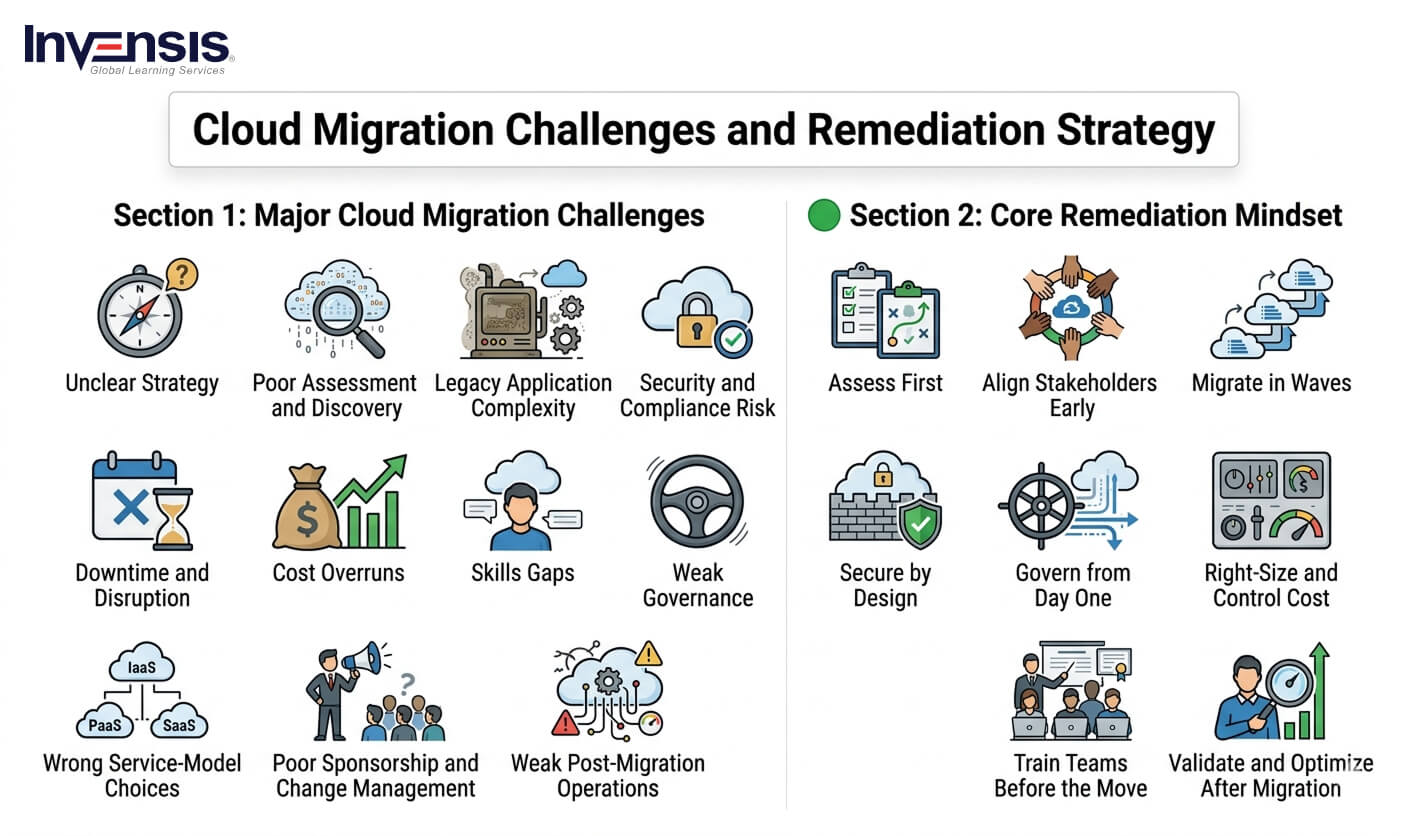
1. Why Is Lack of a Clear Migration Strategy a Major Challenge?
One of the biggest cloud migration problems begins before the migration even starts: the organization lacks a clear reason, scope, or roadmap for the move. Some stakeholders want cost savings, others want modernization, others want greater resilience, and still others simply want to “move to the cloud” because competitors are doing it. When the objective is vague, teams make conflicting decisions, priorities shift mid-program, and success becomes difficult to measure. Google Cloud directly identifies unclear goals and weak cloud adoption strategy as a common migration challenge.
How do You Remediate It?
Use these steps:
- Define the business outcome first, not just the technology target
- Identify which workloads should move and why
- Classify applications by business criticality, complexity, and value
- Create a phased migration roadmap instead of one big-bang move
- Align leadership, IT, security, finance, and operations early
- Decide success metrics before migration begins
AWS recommends alignment and envisioning workshops to connect cloud transformation to business outcomes and create a shared action plan across stakeholders.
2. Why Does Poor Discovery and Assessment Create Migration Failures?
Many migrations fail because teams do not fully understand the current IT estate. They underestimate application dependencies, legacy integrations, database relationships, authentication flows, and infrastructure bottlenecks. Google Cloud warns that poor migration planning often begins when organizations start their journey without fully understanding the complexity of their existing application estate.
Microsoft also highlights that legacy applications often carry hard-coded paths, environment-specific configurations, unsupported software dependencies, and tightly coupled components, making each migration more complex than expected.
How do You Remediate It?
Use these steps:
- Conduct full application and infrastructure discovery
- Map application-to-application and app-to-database dependencies
- Identify unsupported operating systems and software versions
- Assess performance baselines before migration
- Group workloads into migration waves based on complexity and risk
- Test a pilot workload before scaling to critical systems
AWS specifically recommends workload dependency review and migration strategy selection as part of its platform assessment approach, while Microsoft recommends early compatibility assessments and dependency analysis.
3. Why Are Legacy Applications So Difficult to Move?
Legacy systems are among the most common blockers to cloud migration. They may rely on outdated operating systems, tightly coupled hardware, unsupported middleware, or manual processes that do not translate well into cloud-native environments. Microsoft notes that out-of-support operating systems, tightly coupled apps, and dependency conflicts are among the main reasons workload migration becomes difficult.
This is why a blanket migration approach rarely works. Some workloads can be rehosted quickly, some need replatforming, some require refactoring, and some may be better retained or retired. AWS reinforces the need to analyze workloads and select the right migration path instead of treating every system the same way.
How do You Remediate It?
Use these steps:
- Assess whether each application should be rehosted, replatformed, refactored, retained, or retired
- Modernize unsupported operating systems before migration
- Isolate dependency-heavy applications for special handling
- Consider containerization for applications with environment conflicts
- Avoid migrating low-value legacy systems without a clear business case
- Create a legacy modernization roadmap alongside the migration roadmap
4. Why Do Security and Compliance Become Major Roadblocks?
Security is one of the most sensitive parts of cloud migration because organizations must protect data while also meeting legal, regulatory, and internal control requirements. This challenge becomes more severe in regulated sectors such as healthcare, finance, and government. AWS identifies the need to ensure the confidentiality and integrity of cloud workloads as a core cloud transformation challenge.
|
Expert Perspective “We also have to build trust right into our technology. That means you have to have technology that has built-in protections for privacy. It’s got transparency. You have both security and compliance.” |
 |
Microsoft further points out that during database migration, user logins, roles, encryption settings, constraints, and integrity controls must move correctly with the data. A poorly handled migration can expose data, break access control, or create compliance gaps.
How do You Remediate It?
Use these steps:
- Classify data before migration by sensitivity and regulatory requirements.
- Design identity and access management before workload movement.
- Enforce least-privilege access in the cloud environment.
- Validate encryption for data at rest and in transit.
- Map compliance controls from on-premises to cloud equivalents.
- Test backup, recovery, and auditability before production cutover.
- Include security teams in migration planning from day one.
AWS recommends a security blueprint assessment and implementation approach rather than adding security later as a patch.
5. Why Are Downtime and Business Disruption Such Big Concerns?
Downtime is one of the most visible migration risks because it affects users, operations, revenue, and reputation. Even if the technical move succeeds, prolonged disruption can make the migration look like a failure from the business perspective. Google Cloud notes that identifying workload risk tolerance up front helps reduce both planned and unplanned downtime during migration.
Microsoft also stresses the importance of cutover planning, validation, and rollback readiness, especially for database migrations where data integrity and performance must be preserved during the move.
How do You Remediate It?
Use these steps:
- Assess workload downtime tolerance before migration.
- Prioritize low-risk migrations first to validate the process.
- Schedule cutovers during low-usage windows.
- Run repeated migration rehearsals in non-production environments.
- Define rollback criteria and rollback ownership clearly.
- Validate application behavior, user access, and integrations immediately after cutover.
- Use phased or wave-based migrations rather than a full environment switch at once.
6. Why Do Cloud Migration Costs Often Go Beyond Budget?
A common misconception is that cloud migration automatically saves money. In reality, poor cloud migration can increase costs through oversized workloads, redundant environments, partner overruns, delays, and weak governance. McKinsey found that poorly coordinated migrations often exceed planned spend, with unexpected inefficiencies leading to significant waste.
| Expert Insight “Cost optimization in the cloud is not a one-time activity; it’s a continuous discipline.” |
AWS also highlights the challenge of maintaining control over cloud resource usage, cost, and policy as organizations scale in the cloud. Microsoft adds that both undersizing and oversizing are costly in different ways: one affects performance, the other wastes spending.
How do You Remediate It?
Use these steps:
- Create a migration budget by workload or migration wave.
- Perform performance-based right-sizing before migration.
- Define tagging and cost-allocation policies from the start.
- Monitor spend continuously during migration, not only after it.
- Avoid copying on-prem resource sizes blindly into the cloud.
- Include FinOps or cloud-cost accountability in the program.
- Structure vendor and partner contracts around outcomes, not just time spent.
7. Why Do Skills Gaps Slow Cloud Migration Down?
A migration may have the right tools and architecture but still struggle if the team does not have the required cloud skills. On-premises administrators, database teams, network engineers, and security analysts often need to adapt to a new operating model in the cloud. Microsoft explicitly states that on-prem server experts are not automatically fluent in cloud operations and recommends training before and during migration.
McKinsey also highlights a large market-wide cloud talent gap, noting that organizations must hire or reskill substantial numbers of cloud professionals to meet their cloud ambitions.
How do You Remediate It?
Use these steps:
- Assess current team capabilities before migration starts.
- Build a targeted training plan for cloud platforms, operations, and security.
- Create a cloud center of excellence or migration enablement team.
- Use expert partners selectively rather than relying on them completely.
- Document standards, runbooks, and decision frameworks.
- Cross-train operations, security, and application teams together.
AWS recommends readiness assessments and organizational enablement to identify early on blockers, leadership support needs, and skill gaps.
8. Why Do Governance Gaps Cause Cloud Sprawl?
When governance is weak, cloud environments can become chaotic very quickly. Teams may create resources with inconsistent naming, unclear ownership, poor tagging, and weak policy enforcement. Microsoft warns that on-prem controls do not automatically carry over to cloud environments, and without governance from day one, cloud sprawl can grow quickly.
AWS similarly recommends governance-at-scale assessments and launches to define financial, configuration, account, and data governance in the cloud.
How do You Remediate It?
Use these steps:
- Define naming, tagging, and ownership standards before provisioning begins.
- Enforce policy through automation rather than manual review alone.
- Define who can create, modify, and delete resources.
- Establish account/subscription structure aligned with business needs.
- Standardize access approval and compliance monitoring.
- Review governance controls continuously as migration scales.
9. Why Is Choosing the Wrong Cloud Service Model a Serious Mistake?
Another frequent migration challenge is poor technology choice. Organizations may move an application into a cloud service model that does not fit their performance, scalability, integration, or management needs. Google Cloud specifically lists wrong technology choice as a common migration challenge and emphasizes the need to review workloads carefully before choosing the target cloud product and service model.
Microsoft also explains that the wrong service tier for a database or the wrong VM sizing decision can affect both performance and cost.
How do You Remediate It?
Use these steps:
- Assess each application’s performance, compliance, and integration needs.
- Decide whether IaaS, PaaS, SaaS, or container-based models fit best.
- Validate service tier and sizing against real workload behavior.
- Involve architects, database teams, and security stakeholders in the design.
- Pilot critical services before broad rollout.
- Revisit the target architecture if the workload is being modernized, not just moved.
10. Why Do Weak Sponsorship and Poor Change Management Hurt Migration?
Cloud migration is rarely successful if it remains an isolated IT project. It affects budgets, operations, roles, delivery models, governance, and business priorities. Google Cloud identifies lack of sponsorship as a major challenge, while McKinsey found that organizations that outperform in migration are more likely to have active CEO sponsorship and a full implementation roadmap in place up front.
Without executive backing, the migration can lose priority, funding, and organizational support. Without change management, teams resist new tools, workflows, and responsibilities.
How do You Remediate It?
Use these steps:
- Secure visible executive sponsorship before scaling the migration.
- Communicate the business case repeatedly, not only once.
- Define stakeholder roles and decision rights clearly.
- Involve business and operational teams early, not just infrastructure teams.
- Prepare teams for new responsibilities after migration.
- Treat migration as an enterprise transformation program, not a narrow infrastructure project.
11. Why Does the Post-Migration Operating Model Matter So Much?
Many companies focus heavily on moving workloads but far less on how those workloads will be run afterward. This creates a serious gap. After migration, teams still need governance, monitoring, security operations, backup and disaster recovery, access control, performance tuning, and cost optimization. Google Cloud calls out the need for a clear delivery and operational model before, during, and after migration.
|
Expert Perspective “Everything fails, all the time is a useful reminder for cloud migration leaders. The goal is not to assume flawless cutovers; the goal is to build monitoring, rollback, backup, and recovery capabilities that make failure manageable and survivable.” — Werner Vogels, CTO, Amazon |
 |
AWS likewise recommends creating a cloud operating model that defines processes, tools, and capabilities for actually running the cloud environment.
How do you Remediate It?
Use these steps:
- Define operational ownership before production cutover
- Establish monitoring, backup, DR, and incident workflows early
- Document new operational runbooks for the cloud environment
- Assign responsibility for security, cost optimization, and compliance controls
- Perform post-migration reviews after every migration wave
- Optimize workloads after migration instead of assuming the move is the finish line
Why Is Cloud Migration So Challenging?
Cloud migration is difficult because it involves both technical transformation and organizational change. A company may need to assess legacy systems, redesign infrastructure, retrain teams, redefine governance, and adjust security controls all at once. Google Cloud highlights several recurring issues, including unclear goals, lack of sponsorship, poor migration planning, wrong technology choices, and an unclear delivery and operational model.
On the infrastructure side, Microsoft notes that migration is rarely “plug-and-play.” Legacy operating systems may not be supported, performance characteristics may change in the cloud, network and identity dependencies may break, and poor governance can create sprawl almost immediately if controls are not set from day one.
| Research Insight McKinsey found that poorly coordinated cloud migrations can create major value leakage. Its research says cost overruns globally could add up to well over $100 billion in wasted spend over three years if migration inefficiencies are left unchecked. |
What Happens When Migration Starts Without Clear Goals?
One of the earliest cloud migration failures happens before any workload moves. Organizations launch the initiative without agreeing on why they are migrating in the first place. Some teams want lower infrastructure costs, others want modernization, others want resilience, and others simply want to “get to the cloud.” When goals are unclear, migration decisions become inconsistent, priorities drift, and success becomes hard to measure. Google Cloud explicitly identifies unclear goals and lack of a cohesive cloud adoption strategy as common migration challenges.
How Do You Overcome Unclear Goals?
Start with a business case, not a server list. Before migration begins, define:
- What business outcomes matter most.
- Which workloads matter most.
- What timeline is realistic.
- What success will look like after migration.
AWS recommends business alignment activities such as envisioning workshops and alignment workshops to connect cloud efforts to organizational outcomes and build a shared plan among stakeholders.
Why Does Poor Planning Cause So Many Cloud Migration Failures?
Many migrations struggle because organizations start moving workloads before they fully understand the current environment. Dependencies are missed. Applications are grouped incorrectly. Cutover windows are unrealistic. Teams discover hidden complexity only after timelines and budgets have already been committed.
Google Cloud identifies poor migration planning as a major challenge and stresses the need to assess the current application and infrastructure estate before execution. Its migration-factory approach is designed to create repeatable processes, clear goals, and better execution discipline at scale.
Microsoft gives this challenge a very practical shape. It highlights issues such as legacy OS compatibility, app dependency conflicts, performance mis-sizing, and identity/network integration problems, all of which can derail migrations if not discovered early.
How do you Overcome Poor Planning?
A stronger planning model usually includes:
- Full workload discovery and dependency mapping.
- Migration wave planning.
- Right-sizing analysis.
- Pilot migrations for lower-risk workloads.
- Cutover and rollback planning.
- Post-migration operations planning.
AWS specifically recommends R-lane analysis to review workload dependencies and choose the right migration path, while Microsoft recommends early compatibility assessments and app dependency analysis before moving workloads.
| Pro Tip Do not plan migration in a single large batch. Organize workloads into waves based on business criticality, technical complexity, and dependency relationships. That reduces risk and makes issues easier to isolate. |
How Do Security and Compliance Become Migration Roadblocks?
Security is one of the most common reasons cloud migrations slow down. Organizations worry about data exposure, identity control, regulatory obligations, encryption, workload isolation, and audit readiness. These concerns become even sharper in regulated industries where compliance mistakes can create both financial and reputational damage.
AWS identifies the need to ensure the confidentiality and integrity of data and cloud workloads as a core cloud transformation challenge. It recommends a security blueprint assessment and implementation based on structured architecture and security controls rather than trying to “bolt security on” later.
Microsoft makes the same point at the workload level. In database migrations, it warns that user logins, roles, encryption settings, and security controls must move correctly with the data, and that data integrity validation must be built into the process.
How do you Overcome Security and Compliance Risks?
The most effective approach is to design security into the migration from the start:
- Classify data before migration
- Map regulatory requirements workload by workload
- Validate identity and access design early
- Use least-privilege access
- Test encryption, backup, and recovery controls
- Validate compliance evidence as part of the migration workflow
| Avoid This Mistake Do not assume your on-premises security model will automatically transfer to the cloud. Cloud environments require deliberate redesign of identity, access, monitoring, and configuration controls. |
Why Do Cloud Migration Costs Often Spiral Out of Control?
Cloud migrations often begin with a cost-saving narrative, but poor execution can do the opposite. Cost overruns happen when workloads are oversized, dependencies cause delays, outside partners are mismanaged, or the migration scope keeps changing. McKinsey reports that the average company in its study experienced 14% more migration spend than planned each year, with spending on systems integrators among the most cited cost overruns outside of change management.
AWS also highlights cost control as a governance challenge as organizations scale in the cloud. Without governance at scale, resource usage, provisioning, and policy enforcement can quickly become difficult to manage.
Microsoft adds a tactical view: undersizing leads to poor performance, but oversizing creates wasted spend. That is why performance-based recommendations and right-sizing assessments are essential before migration.
How do you overcome cloud cost overruns?
Use financial discipline from day one:
- Establish a migration budget by wave
- Track forecast vs. actual spending
- Define tagging and cost-allocation policies
- Right-size workloads instead of copying on-prem sizes blindly
- Align partner contracts with performance outcomes rather than time spent
Why Do Skills Gaps Slow Migration Down?
A cloud platform changes not only infrastructure but also the skills needed to operate it. Teams that are strong in on-premises administration may not yet be comfortable with cloud-native architecture, automation, identity patterns, policy enforcement, or cost optimization. Microsoft explicitly states that on-prem server experts are not automatically fluent in Azure operations and recommends investing in training both before and during migration.
McKinsey reinforces the scale of the challenge. It estimates that to meet cloud ambitions, organizations globally would need to hire or reskill at least one million new cloud developers over three years, which puts even more pressure on an already constrained talent market.
How do you Overcome Cloud Skills Shortages?
A realistic approach includes:
- Training current staff before migration waves begin
- Creating cloud center-of-excellence or enablement teams
- Pairing internal teams with specialists strategically
- Building runbooks and operating standards
- Using automation to reduce manual operational burden
AWS recommends readiness assessments and organization enablement initiatives to identify skill gaps, leadership blockers, and structural barriers before migration scales.
How Do Legacy Applications and Dependencies Create Migration Risk?
Legacy systems are among the hardest elements to migrate because they often carry years of undocumented dependencies, hard-coded paths, unsupported software versions, or tight coupling to specific hardware and network conditions. Microsoft says legacy application complexity can make each app feel like its own mini migration project, especially when dependencies and framework versions are not compatible with the target cloud environment.
AWS likewise recommends evaluating workloads using migration strategies such as rehost, replatform, refactor, relocate, retire, or retain, rather than assuming every workload should be migrated in the same way.
How do you Overcome Legacy Complexity?
The answer is not always “migrate everything.” For each workload, decide whether to:
- Rehost it quickly
- Replatform for moderate improvement
- Refactor for cloud-native value
- Retain it temporarily
- Retire it completely
Some applications are more valuable to modernize than migrate. Others should be retired if they no longer justify the cost and effort.
| Pro Tip Treat application assessment as a business decision as much as a technical one. A low-value legacy application may not deserve the same migration effort as a high-value customer-facing platform. |
What Does a Strong Cloud Migration Approach Look Like?
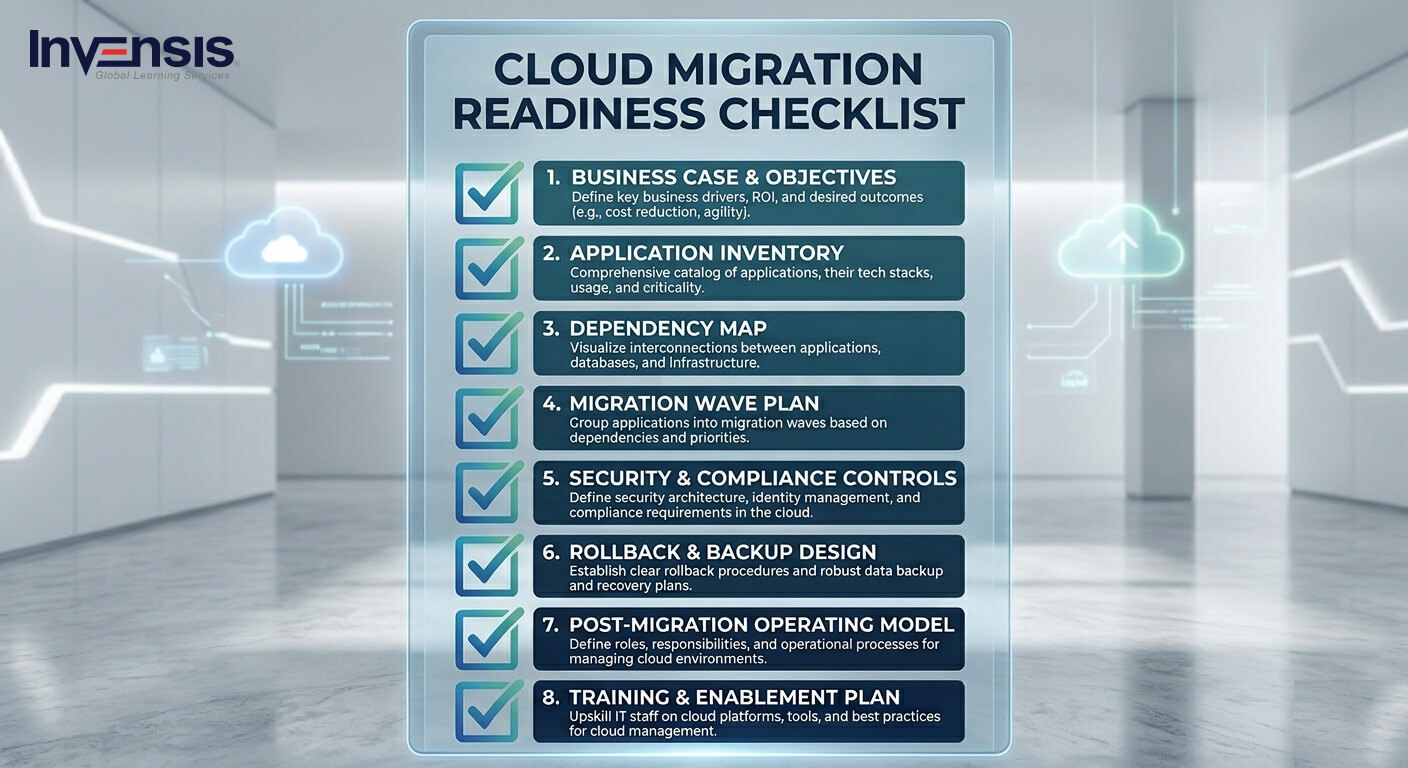
A strong migration approach is structured, iterative, and business-led. Across AWS, Google Cloud, Microsoft, and McKinsey, the pattern is clear: successful organizations align leadership, assess workloads deeply, choose the right migration path for each application, establish governance early, invest in skills, and automate wherever possible. In practical terms, that means:
- Align on business outcomes
- Secure executive sponsorship
- Assess applications and dependencies
- Migrate in waves
- Build security and governance into the design
- Train the operating teams
- Measure both technical and business outcomes after each wave
What Is the Final Answer to “How Do You Overcome Cloud Migration Challenges?
You overcome cloud migration challenges by refusing to treat migration as a simple infrastructure move. The organizations that succeed are the ones that treat cloud migration as a business transformation program with technical, operational, financial, and people dimensions. That means better planning, stronger executive sponsorship, deeper workload analysis, earlier governance, stronger skills development, and a realistic post-migration operating model. The good news is that the same sources that describe the problems also point to the solution. Assess early. Automate aggressively. Govern from day one. Train teams before the move, not after. And most importantly, connect migration decisions back to business value at every stage.
Conclusion
Cloud migration succeeds or fails based on how seriously organizations treat it as a transformation, not just a technology shift. The patterns are clear: unclear goals, weak planning, poor governance, and skill gaps consistently derail outcomes. The companies that get it right take a structured, wave-based approach, align migration to business value, embed security and governance from day one, and invest early in capability building. They don’t rush into execution; they build clarity, test assumptions, and iterate. That discipline is what turns migration from a cost-heavy initiative into a long-term competitive advantage. To execute this effectively, organizations also need the right skills and frameworks in place. Investing in structured learning programs such as AWS DevOps Certification Training and Azure Devops training helps teams build expertise in cloud architecture, governance, operations, and service management. These capabilities ensure that migration is not just completed successfully, but sustained and optimized over time, delivering real business value beyond the initial move.